Biomass Harvesting Drones: Replacing Fossil Fuels And Managing Natural Habitat
Summary:
Drone based selective harvesting of biomass from farmland and natural habitat scales to replace all fossil fuels at much lower cost (~$20/barrel possible). It also generates an average of around $500 per hectare per year in revenue which increases incomes, substantially restores natural habitat and biodiversity, averting a mass extinction, and removes enough carbon to stop global warming. By generating substantial revenue, which is competitive with low productivity farming, natural habit pays for its restoration and preservation. Economic value currently collected by the fossil fuel industry is effectively transferred to farmers. This technology scales to disrupt the entire fossil fuel industry, providing the world with a sustainable and democratized source of hydrocarbons at much lower cost.
Drones carry wood chipper tool attachments, which allows them to effectively graze on farmland and natural habitat. They selectively remove biomass in a way that helps manage the habitat and they are not constrained by terrain. For example, removing deadwood, undergrowth, and dry grass in wildfire vulnerable areas. They return this biomass to a centralized location for conversion into valuable hydrocarbons, or for direct conversion into low-cost on demand energy, for example, via a thermophotovoltaic generator. Effective drone range can be tens of miles and solar powered charging stations can be self deployed if needed. Ash content, including nutrients, which can also be enhanced, can be returned directly to the soil. Soil quality can be built up and desired plants seeded while undesired plants are selectively removed, for example, invasive species, significantly improving biodiversity and biological productivity, and also increasing resilience, including drought resistance. Biomass harvesting drones enable terrain independent active habitat management and optimization.
General concept:
Biomass harvesting drones are optimized for selectively harvesting biomass from natural and unnatural habitats and returning this biomass to a centralized location which also includes charging infrastructure. The operating range of biomass harvesting drones can be up to tens of miles. Biomass harvesting drones can automatically attach different tools for different tasks. Typically this might be a wood chipper type attachment with a containment volume for transporting wood chips for processing dead wood. Wood chipping might typically require energy on the order of 1% to 2% that of the chemical energy of the wood. Other attachments optimized for other tasks would also be included. For example, grass and foliage cutting and collecting, pruning, plant pulling, fertilizing, planting, watering, trash collection, and so forth. Six axis drone precision flight capability, including in strong winds, is critical to this capability, also autonomous battery charging and biomass transfer. Biomass harvesting drones can scale from just a few kilograms into the tens of metric tons range. From biomass collection and charging stations, which in some cases could be much larger drones, biomass can be further transported by more optimized cargo transport drones to biomass end users (transporting biomass hundreds of miles is economically possible). Biomass markets might include animal feed, those using biomass directly to power thermophotovoltaics backup generators, and also bio-oil refineries for converting biomass into high quality hydrocarbons that might be used for fuels or precursors to chemical processes. Biomass is a low cost density material and it is generally cost prohibitive to transport it long distances. Transport costs define a lot of the economics around biomass. Converting biomass to higher value hydrocarbons greatly improves the transport economics and there is an optimization around the size, number, and distribution of bio-oil refineries. This is further influenced by how distributed the demand for biomass and hydrocarbons is. Biomass harvesting drones and associated bio-oil refineries have the capacity to greatly shorten supply lines and distribution systems, which can have a very large impact on reducing overall costs and democratizing the supply and use of hydrocarbons. The terrain and reach independence of biomass harvesting drones combined with cargo transport costs comparable to trains are what enables biomass harvesting drones to achieve ~$20/barrel equivalent hydrocarbon costs.
Scale:
Global photosynthesis is around 130TW, which is around eight times greater than direct global energy use. A little over half of this occurs on land and we farm over half the world’s productive land. Biomass has the potential to scale to replace all fossil fuels. In addition, with direct integrated fertilization natural habitat biological productivity might be increased by an average of around 30%, and active habitat management and yield optimization should increase this, and associated biodiversity, yet further. A substantial sustainable source of hydrocarbons is critical to serve difficult to decarbonize energy use cases such as long term energy storage and various industrial and transportation use cases. Specific examples include distributed on demand energy production to complement solar and battery systems, the production of ~500 million metric tons of plastics, and liquified methane for rocket vehicles and moving data centers to space. Biomass is the only sustainable hydrocarbon source that scales sufficiently at low enough cost to serve these needs. Electrofuels, where carbon dioxide is extracted directly from the air and combined with hydrogen from the electrolysis of water can scale, but is inherently much more expensive. The raw cost of biomass is on the order of $0.01/kWh of chemical energy (~$50/metric ton). Electrofuels must start with electricity, which is generally significantly more expensive than this, and then add capital, operations and maintenance, and inefficiency costs associated with conversion. Electrofuels for less than three times the cost of biomass seem unlikely.
Forestry:
Many natural habitats are not easily accessible by land based biomass harvesting systems. Tree harvesting systems and equipment provide some indication of how difficult it is to operate in challenging terrain. Indeed drones might be used for both much lower cost helicopter logging and forestry slash clean up. There is also the tethered wing drone approach that can efficiently scale to payloads in the hundreds of metric tons, which is perhaps useful for logging. Bridled tethered wings, which have structural load distribution comparable to suspension bridges, can scale to even larger sizes than fixed wing aircraft and by circling around a given location can raise and lower very large payloads vertically and transition to and from forward flight. Helicopter logging does not require roads and has much lower environmental impact. It can also efficiently operate in a continuous and highly selective manner over very large areas, avoiding the need for clear felling. Forestry slash, which includes the branches and small tree sections that can not be efficiently logged, often has zero effective value. It is often left on the ground to biodegrade and return nutrients to the soil. Forestry slash can account for up to half of the above ground tree mass. Being able to remove roots and process them into biofuels, returning nutrients to the soil, would also be highly desirable. The cost of forestry slash is primarily determined by the cost of collection and transport to a central location. Use of autonomous biomass harvesting drones enable this cost of collection and transport to be dramatically reduced such that the revenue generated can primarily go to the land holder. This becomes a substantial additional revenue stream that can in many cases exceed the value of logs harvested. Using continuous highly selective and sustainable logging and biomass harvesting practices, it is compatible with sustaining a diverse and healthy forestry ecosystem.
Habitat management:
A critical capability of biomass harvesting drones is that they enable direct habitat management that can increase yields, increase resilience, increase biodiversity, and help stop global warming. Firstly, biomass harvesting drones can be used to directly remove undergrowth and other combustible biomass that might contribute to wildfires. Enabled by AI they can further do this on a highly selective basis that discourages undesired species and encourages desired species. Invasive and over populated species can be directly targeted. The drones could also be used for direct fire fighting given access to a suitable water source. The drones might also use a multitude of other tools to accomplish different tasks. Extensive imaging and monitoring of the local habitat would be a byproduct of general drone activity, this would include measurement of growth of different species, year round growing conditions, and so forth. Dedicated tools might be used for planting and protecting seedlings of species optimized to local conditions, increasing the ability to adapt to climate change. Active fertilization could significantly increase yields, especially in borderline environments, for example, those affected by drought, helping to reestablish rain cycles. Drones could also be used to harvest wild foods and animal feed, which could provide additional revenue streams and food security. For example, hay for animal feed can have greater value than biomass for hydrocarbon production, and harvesting it from natural habitat could reduce the need for farmland. In natural habitats, dry grasses are often uneaten and left to biodegrade. Collection and conversion to silage can improve their palatability. Drones also enable the integration of natural habitat and farmland, managing natural habitat intermixed with farmland can have substantial mutual benefits. For example, use of hedgerows and agroforestry. Farmland has displaced over half of the world’s productive land leading to a mass extinction and global warming. Done based active habitat management and yield increases could largely mitigate this.
Economics:
Thermophotovoltaic cells have achieved efficiencies of 44% at 1435C. These cells can operate at much higher energy intensities than standard solar cells and are subject to similar cost reduction curves - potentially they can have lower costs per power output. Biomass harvesting drones combined with incinerators with integrated thermophotovoltaic power generation could achieve efficiencies in excess of 30%. A recuperator is required that uses exhaust gases to preheat incoming air, and this might have an efficiency of around 80% to 90%, which limits overall efficiency. Water cooling of the thermophotovoltaic cells is likely also desired. With mass production and associated cost reduction curves a few hundred dollars per kilowatt should be possible. Combined with ~$0.01/kWh(t) biomass this suggests on demand scale independent co-located power generation for around $0.05/kWh. This is substantially less than the cost of grid supplied electricity and it is highly complementary with highly distributed low-cost solar and battery systems. This enables year round off grid electricity for small and large users alike, including large cities, industrial plants, data centers, and charging stations for biomass harvesting drones, at less than $0.05/kWh. In practice this system might also use municipal waste as a feedstock, which often has a negative cost, but biomass feedstocks are capable of much greater scale.
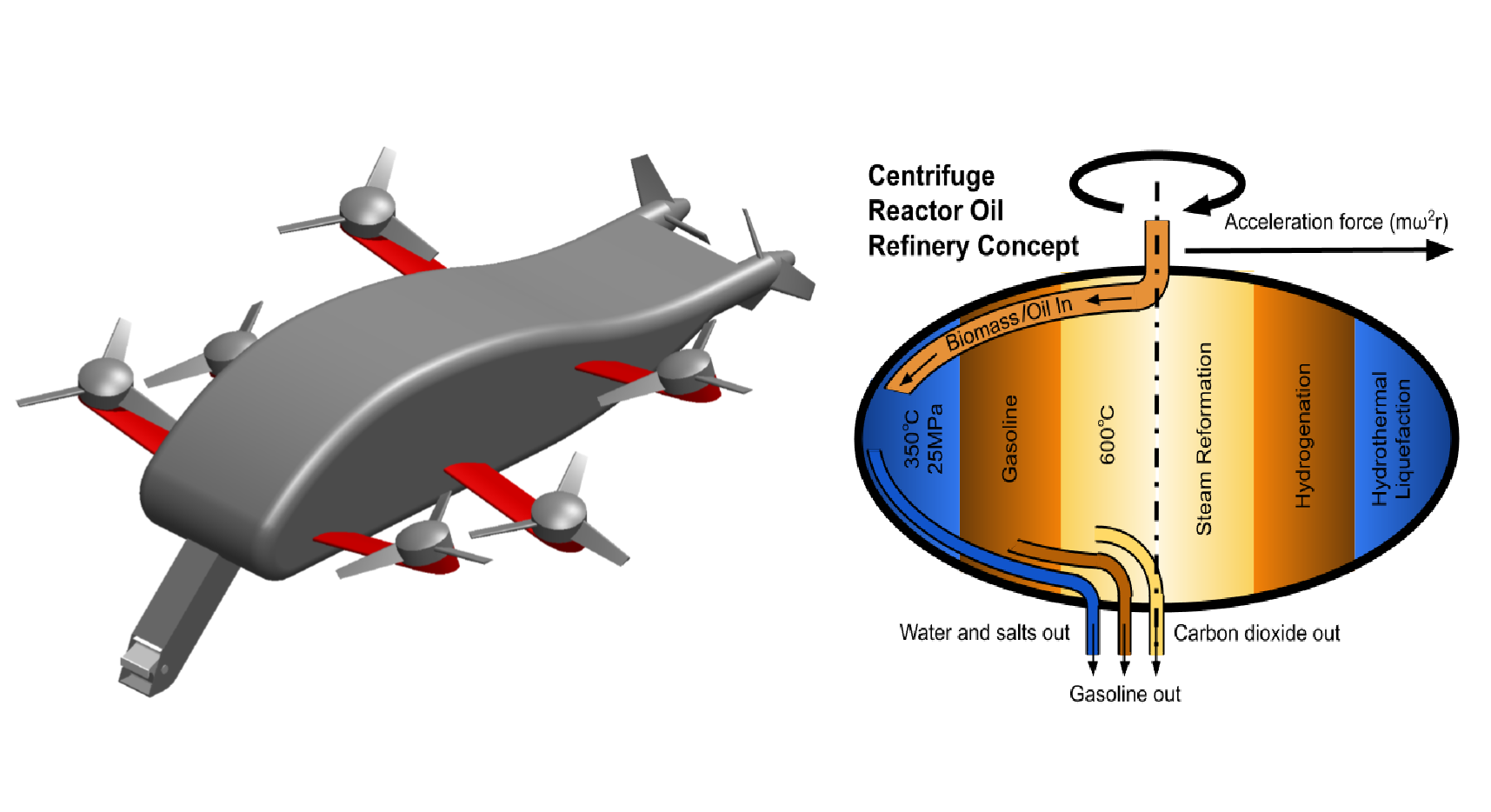
Oil refineries achieve efficiencies of around 90% at costs as low as $3 per barrel. The centrifuge reactor is an example of one type of miniaturized integrated oil refinery that might achieve these efficiency and cost levels while using biomass as a feedstock. The centrifuge reactor is applicable to distributed and even mobile operation. It could potentially even be integrated into a large drone, or at least carried by one to remote sites where it might serve a fleet of biomass harvesting drones. Assuming $50 per metric ton biomass this would equate to around $20 per barrel, which is substantially less than the market price of crude oil. Further, this would be for a refined product that could be used directly in a distributed manner, bypassing a large fraction of fossil fuel distribution costs. Many areas would become self-sufficient in hydrocarbons. In a mature industry, the cost of biomass harvesting drones would be less than 10% of the biomass cost and most of the revenue collected would go to the land holder. For example, a 12.5kg drone might have a ~12.5kg payload, cost a few thousand dollars, use ~$0.20/hour in energy, cost less than $1/hour to operate, and collect around 250kg of biomass per hour. Typical yields might be on the order of 10 metric tons per hectare per year, equating to a revenue stream of around $500 per hectare per year. This is significantly higher than the revenues generally associated with forestry, and given that the input costs are very low it is generally competitive with farming. A consequence being that reforestation will become economically favored.
Impact:
Biomass harvesting drones will disrupt the fossil fuel industry, democratizing hydrocarbons and providing low-cost energy for all. It will also economically compel large scale reforestation, stopping a mass extinction and global warming in the process. Global oil and gas is a ~$8 trillion market and coal is another roughly $2.5 trillion. This will be disrupted with most of this revenue will effectively get transferred to land owners - farmers in many cases. Around one quarter of the global work force gets their primary income from farming, many of whom are on a very low income, so this would have an extremely beneficial impact on reducing poverty. The availability of ~$0.05/kWh on demand electricity at almost any scale will enable solar and battery systems to go fully off grid and scale rapidly. This will disrupt the electricity grid, greatly reduce electricity prices, and greatly accelerate electrification for all. Biomass harvesting drones will provide a sustainable much lower cost hydrocarbon resource that can scale substantially beyond current demands, powering the future with abundant low-cost energy.