Finite Element Control Mesh For Fusion And Plasma 3D Printing
Summary:
By placing a dense array of plasma control elements around a plasma we can potentially control that plasma with high spatial and temporal resolution. For fusion this enables active plasma stabilization and direct energy conversion. It also enables direct 3D plasma printing and machining, including large physical objects, solar cells and energy systems, power electronics, and even high performance computer chips with nano scale resolution. A finite element control mesh might primarily consist of a mesh of electrodes controlled by GaAs transistors at 100GHz to 1 THz frequencies (1 to 10 picosecond switching speeds). GaAs transistors also have reasonable resistance to radiation. Z-pinch fusion, for example, is simple, small, and robust and applicable to both energy production and fusion rockets, which would open up the solar system for effectively unlimited resources, energy, and cooling. But it is limited by plasma instability. Shear flow stabilization z-pinches have sustained fusion conditions for ~10 microseconds, ~1 million times longer than GaAs transistor switching speeds suggesting that active plasma stabilization and continuous fusion might be possible.
The finite element control mesh can incorporate many other elements, including electromagnets, phased array antennas, radio and microwave systems, imaging systems, laser arrays, and so forth. With many inputs and many outputs finite element control meshes can be coupled with machine learning approaches for controlling plasmas. Combined with very low-cost energy this could enable on demand manufacturing of complex components, perhaps including the refining of materials from raw ores. Manufacturing could become more distributed and greatly accelerated. Plasma 3D printing systems may have some capacity to replicate themselves, and associated energy production and resource mining and refining infrastructure, enabling rapid exponential scaling of the technology.
Concept:
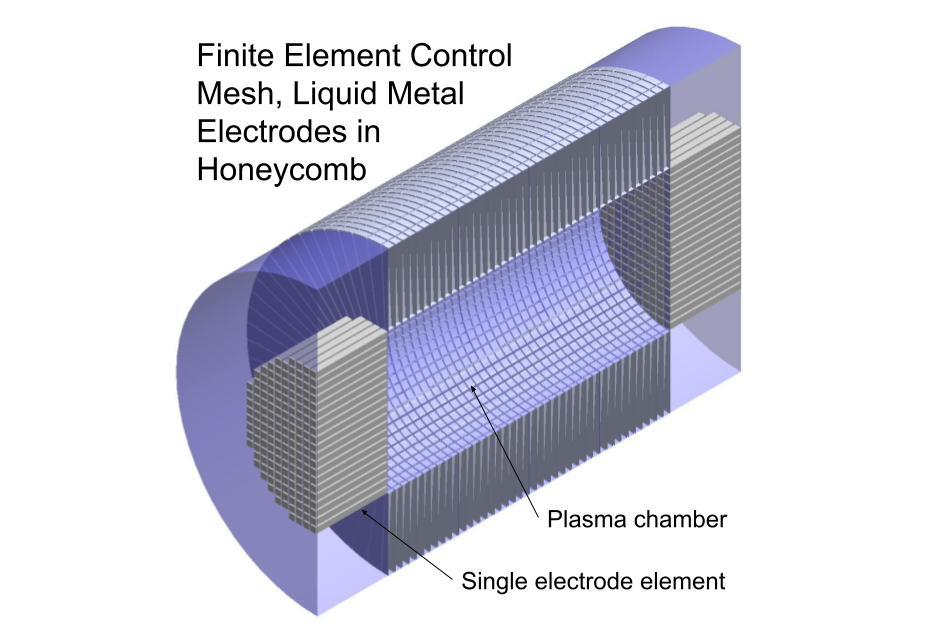
A finite element control mesh for controlling plasma at high spatial and temporal resolution can take many forms but the essential concept is to use many thousands if not millions of control elements combined with AI for actively stabilizing and manipulating plasmas. Primary control elements might be electrodes, as these can be constructed using self regenerating liquid metal approaches, perhaps within a fused quartz honeycomb structure, that can survive long term plasma exposure including radiation tolerance while also having very fast response times. For fusion, required radiation shielding might be on the order of 100 millimeters to 200 millimeters (perhaps less for fusion rockets). This results in a speed of light delay with respect to control element response times which can be restrictive. The same control mesh principle can also be applied to magnetic fields, electric fields, charged and neutral particle beams, laser arrays, physical compression and expansion, electromagnetic imaging and heating (microwave/radar), and so forth. Further, multiple sensing and actuation meshes of different forms can be overlaid to improve overall performance. In some scenarios power electronics might be integrated directly into electromagnetic elements so as to speed up response time, which for coil elements can be induction limited. One of the overall objectives is to accomplish as much of the plasma control and confinement within the plasma itself as possible. For example, vacuum tube amplifiers, plasma rail guns, and so forth, might to varying degrees be formed within the plasma and used for primary brute force control via amplified means. High temperature plasma can be highly conductive and it is generally preferable to use it for large current flows rather than external coils.
The finite element control mesh might also be applied to much lower temperature plasmas, for example, those utilized in plasma erosion and deposition. Materials could be selectively vaporized and deposited with a potentially very high degree of spatial resolution. Plasma ion beams are capable of sub-nanometer accuracy. Many plasma beams can be simultaneously precisely guided and used for both the erosion and deposition of elements; phased array antennas producing multiple microwave beams is indicative. The erosion case might be used for subtractive manufacturing, effectively using plasma beams to machine an object into a desired shape while depositing removed material at a given location. Alternatively, with access to a solid feedstock of high purity elements those elements might be selectively converted into a plasma and guided to a specific location for deposition. Plasma erosion and deposition might also be used at greater scales than a small beam, with larger scale plasma erosion and deposition processes acting over larger areas with the erosion and deposition rates and distributions actively controlled over these areas. This might enable higher erosion and deposition rates and also the precise control of erosion and deposition rates for high production rate roll to roll type processes. For example, plasma erosion and deposition of films, solar cells, or like. Doping of elements would also be possible for the direct creation of semiconductors.
Fusion:
A z-pinch is where current flowing through a plasma creates a magnetic field in the plasma, similar to the magnetic field around an electrical wire, that compresses the plasma around the z-pinch which then increases the conductivity of the plasma further increasing the z-pinch. This is able to achieve the extreme temperatures and pressures needed for fusion. This is how lightning works and as one might expect from the positive feedback dynamic response, it is subject to substantial plasma instabilities, kink and sausage instability modes being somewhat descriptive. Shear flow, where the plasma around the z-pinch is axially accelerated to significant proportions of the speed of light, can help stabilize the z-pinch. Shear stabilized z-pinch fusion systems have achieved stable fusion for 10-100 microseconds. Without shear flow stabilization fusion stability might only last 1 to 10 nanoseconds - also potentially within the control authority of a finite element control mesh. By using the finite element control mesh to create the equivalent of plasma railguns within the plasma high-speed shear flows might also be created to help with plasma stabilization. Another approach might be to create the equivalent of vacuum tube amplifiers within the plasma, effectively creating computation and active stabilization within the plasma itself, which could potentially enable even faster and more radiation tolerant control responses than the finite element control mesh alone.
Many of these processes can also be inverted, enabling direct energy conversion which is critical to effective small scale fusion. For example, plasma flows and instabilities can be powered by fusion with the finite element control mesh then used to extract energy directly from these flows and instabilities. The equivalent of heat engines can also be created within the plasma where variation in plasma pressure and volume can be used to directly extract power. Plasma heat engine efficiency can be extremely high given that high end temperatures can be in the many millions of degrees. This is also critical for reducing cooling requirements.
Z-pinch fusion systems are interesting because they can be very compact and simple, not requiring external coils and potentially being only a few meters long and weighing less than one metric ton. They might use a liquid lithium blanket for tritium production, radiation shielding, and even gold production, and they might also be used for fusion rockets. There are over forty different fusion companies, with many different fusion approaches being explored. Finite element control meshes are applicable to a large fraction of these approaches and this is an obvious direction to proceed given recent advancements in AI control technologies that can enable these new capabilities.
Plasma 3D printing:
Finite element control meshes enable direct plasma deposition and erosion based 3D printing and subtractive manufacturing, including mechanical components in a wide variety of materials, and even substrates and semiconductors. For example, plasma chemical vapor deposition might be used to directly create crystalline silicon structures and other substrates. This should generally enable the direct 3D printing of power electronic components and solar cells, which would enable a dramatic up-scaling and cost reduction of solar energy and battery systems. With plasma ion beams capable of nanometer level accuracy and the ability to vary element deposition, including doping, and also perform subtractive machining, this presents a possible direct pathway to the construction of nano-scale high performance computing chips. This could dramatically reduce the capital required and cost of advanced chip manufacturing, enabling smaller scale more distributed manufacturing. This could be particularly applicable to extra terrestrial resource utilization, for example, lunar and asteroid mining and the production of space data centers. Fusion rockets could make these resources readily accessible. The vacuum of space could help maintain the needed plasma conditions and might also allow for scaling to very large sizes.
Plasma 3D printing could be transformative, potentially scaling very rapidly, perhaps using low-cost renewable energy, and enable distributed manufacturing and increased manufacturing self-sufficiency. Plasma 3D printing can help manufacture the low-cost energy systems to power it, the mining and refining materials to feed it, and more plasma 3D printing systems to scale it, creating a virtuous exponential cost reduction and scaling feedback loop. Very large structures could potentially be directly 3D plasma printed. Plasma 3D printing could increase manufacturing security and reduce sensitivity to supply chains enabling much greater use of local resources. It might also enable the direct manufacture of six axis drone systems that might help build the resource extraction, supply chains, and energy systems to power it and modern civilization, bringing about an age of abundance. In some scenarios some degree of element and isotope separation might also be possible, using atomic mass and charge differences to separate different elements and isotopes, although high purities might be challenging, requiring many enrichment cycles, and there are other technologies that might be integrated for achieving this. Finite element control meshes open up the relatively untapped new field of plasma engineering - engineering in the fourth state of matter, which is still in its infancy, but is now possible.